
You are using an out of date browser. It may not display this or other websites correctly.
You should upgrade or use an alternative browser.
You should upgrade or use an alternative browser.
2015 Djokovic is the best season of the Open Era, better than 1969 Laver
- Thread starter junkieballer
- Start date


Third Serve
Talk Tennis Guru
I don't really fault him for missing out on the AO because that Slam just wasn't taken as seriously in those days (held in December, significantly lower prize money than the other 3, not many top players competed). I think that distinction makes it hard to really count the AO against those older players. Mac was dominant enough everywhere else that it isn't a huge deal for me.McEnroe had an amazing win/loss record but “only” won 2 slams. How is he above Fed and Novak?

Giocoswitch
Semi-Pro
Totally agree that Mac 84 is the best OE year after Laver, despite all my Djoko 2011+15 love. I know there's no real consolation for something like 84 FO, but at least Mac losing that match spared you decades of headaches debating why his 3 slams in a year were better than Laver's 4 if you think about it like that.Give me the CYGS every day and twice on Sunday.
Mac’s 1984 season is the only one that comes close; due to how badly that he murdered his opponents. And that season still is the bench mark for the highest winning pct for a season. Also, he was 17-1 vs the top-5 with 12 straight set blowouts. That damn 1984 FO final still ticks me off to this day(most painful loss for me during my 47 years of watching tennis). Mac failed the test that day. Laver won the biggest tourneys and that’s ultimately what matters the most.

Giocoswitch
Semi-Pro
Is the statistical superiority enough to put Djoko 15 over 11? I'm curious, since the value put on the post-USO stretch of the season seems to vary depending who you ask.Pretty much the only real difference between Fed's 2006 and Djokovic's 2015 is two clay Masters, which can be very easily accounted for by the gap in Nadal's form...
The two are pretty much side-by-side (and similar in a lot of ways, down to them both having a subpar AO by their standards). I lean Fed slightly.
Both a shade below Mac 1984 and Laver 1969.

AnOctorokForDinner
Talk Tennis Guru
McEnroe would have most likely played AO if he'd won the first three slams, just for potential CYGS glory. Even Borg, in whose time AO was an altogether second-rate tournament, said he'd have played AO if he was ever going for the Grand Slam.Totally agree that Mac 84 is the best OE year after Laver, despite all my Djoko 2011+15 love. I know there's no real consolation for something like 84 FO, but at least Mac losing that match spared you decades of headaches debating why his 3 slams in a year were better than Laver's 4 if you think about it like that.
AnOctorokForDinner
Talk Tennis Guru
AO wasn't a full-fledged major yet, missing it wasn't such a big deal.McEnroe had an amazing win/loss record but “only” won 2 slams. How is he above Fed and Novak?

Vincent-C
G.O.A.T.
"Figures don't lie, but Liars figure." -Samuel ClemensNumbers are objective.
Only sometimes, though.

FlyingSaucer
Hall of Fame
Hah, stupendous"Figures don't lie, but Liars figure." -Samuel Clemens

Third Serve
Talk Tennis Guru
I think 2011 Djokovic was better for the majority of the year but he fell off a cliff post-USO (owing to injury) while 2015 had a great indoor season and YEC. That's enough to nudge 2015 over slightly, even if I think 2011 hit higher heights.Is the statistical superiority enough to put Djoko 15 over 11? I'm curious, since the value put on the post-USO stretch of the season seems to vary depending who you ask.
Giocoswitch
Semi-Pro
Fair enough. For me being 10-1 against good versions of Fedal and that one loss being the only proper defeat from the start of the year to the end of USO is borderline inconceivable, even if I understand that the manner of some wins in that stretch doesn't convince everyone. Quibbling about the level makes sense, but you can't argue with the outcomes of that 9 month stretch. There are worse reasons for falling off a cliff than injury, too.I think 2011 Djokovic was better for the majority of the year but he fell off a cliff post-USO (owing to injury) while 2015 had a great indoor season and YEC. That's enough to nudge 2015 over slightly, even if I think 2011 hit higher heights.
2015 was obviously an all time great and legacy-affirming year after its disappointing predecessors, but I'm not sure the trade off in statistical dominace and titles is worth the inferior record against worse versions of his main rivals. Not that 2011 Fedal weren't also somewhat worse than for instance 06 Nadal, but I think it's much easier in the latter case to make an argument about the h2hs being 2-4 vs 10-1 etc. Hence I tend to lean Djoko 11 over 15, but your rationale is equally valid and some days I'm partial to it myself since I'm generally not someone who obsesses about level.

ghostofMecir
Legend
Imagine in “the best season ever” getting destroyed on your favorite surface twice by old Federer, beaten another time, winning while having a dominance ratio less than 1.00, and eeking out a close win.1969 Laver had the CYGS but Roland Garros and Australian Open were nowhere near current importance, many top players skipped them. On UltimateTennisStatistics they only have a 72.2% and 55.0% participation rate.
In the 10 tournaments with the highest participation rate of the year, 2015 Djokovic won 8 titles and reached 2 finals.
In the 10 tournaments with the highest participation rate of the year, 1969 Laver won 5 titles and reached 2 finals.
In the 16 tournaments with the highest participation rate of the year, 2015 Djokovic won 11 titles and reached 3 finals.
In the 16 tournaments with the highest participation rate of the year, 1969 Laver won 8 titles and reached 3 finals.
2015 Djokovic had a significantly better win percentage overall and against top players while only playing a small amount of matches less than 1969 Laver.
Overall score:
2015 Djokovic 82-6 (93.2%)
1969 Laver 95-14 (87.2%)
Matches played against top5s:
2015 Djokovic 16-4 (80.0%)
1969 Laver 18-6 (75.0%)
Matches played against top10s:
2015 Djokovic 31-5 (86.1%)
1969 Laver 35-10 (77.8%)
Matches played against top20s:
2015 Djokovic 41-5 (89.1%)
1969 Laver 58-13 (81.7%)
Matches played against top50s:
2015 Djokovic 56-6 (90.3%)
1969 Laver 74-14 (84.1%)
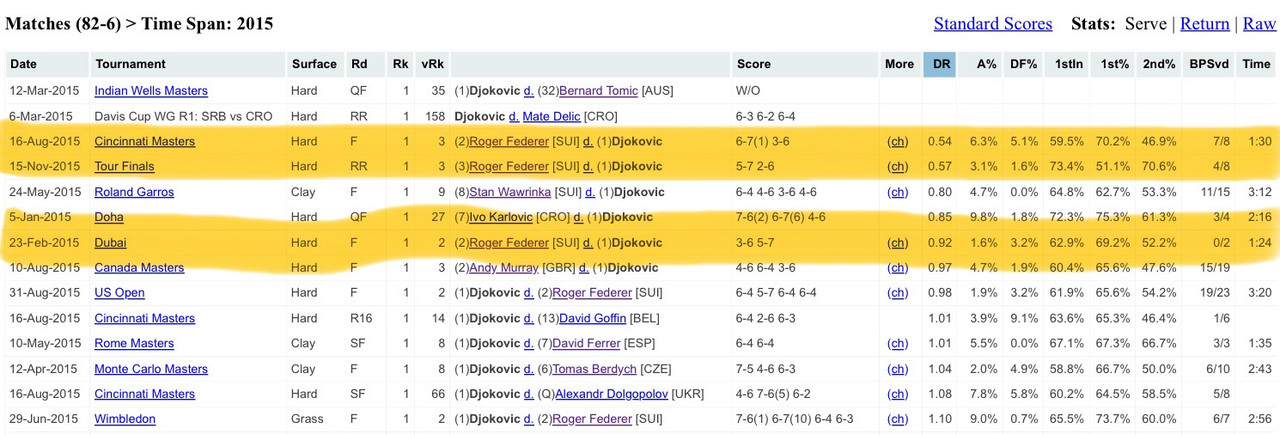

junkieballer
Legend
Yeah Federer was peaking, but Nole still left him without Slams and YEC titles.Imagine in “the best season ever” getting destroyed on your favorite surface twice by old Federer, beaten another time, winning while having a dominance ratio less than 1.00, and eeking out a close win.
“I think I’m a better player now than when I was at 24 because I’ve practiced for another 10 years and I’ve got 10 years more experience,” Federer said. “Maybe I don’t have the confidence level that I had at 24 when I was winning 40 matches in a row, but I feel like I hit a bigger serve, my backhand is better, my forehand is still as good as it’s ever been, I volley better than I have in the past. I think I’ve had to adapt to a new generation of players again.” (Federer, August, 2015)
helterskelter
G.O.A.T.
Exactly. Mac had Connors and Lendl to battle with. Djokovic had old Fed, Murray and Wawrinka.
I know that Connors was 31-32 in 1984, while Federer was 33-34 in 2015, but given that it was easier for players to maintain a decent level for longer in 2015 than it had been in 1984, I think they were about equally old in tennis terms in those years (e.g. about equally far from what they had once been).
helterskelter
G.O.A.T.
Fair enough. For me being 10-1 against good versions of Fedal and that one loss being the only proper defeat from the start of the year to the end of USO is borderline inconceivable, even if I understand that the manner of some wins in that stretch doesn't convince everyone. Quibbling about the level makes sense, but you can't argue with the outcomes of that 9 month stretch. There are worse reasons for falling off a cliff than injury, too.
2015 was obviously an all time great and legacy-affirming year after its disappointing predecessors, but I'm not sure the trade off in statistical dominace and titles is worth the inferior record against worse versions of his main rivals. Not that 2011 Fedal weren't also somewhat worse than for instance 06 Nadal, but I think it's much easier in the latter case to make an argument about the h2hs being 2-4 vs 10-1 etc. Hence I tend to lean Djoko 11 over 15, but your rationale is equally valid and some days I'm partial to it myself since I'm generally not someone who obsesses about level.
Is this true? I suppose it's true that Nadal played better on clay in 2006 than he did in 2011 (though at Roland Garros itself, I think the difference was marginal), but I would put his grass-court performances roughly equal across both years, and I believe that he was considerably better on hard courts in 2011 than he had been in 2006. Or did you mean to say that Federer was worse in 2011 than he had been in 2006 (which is much more clearcut)?
junkieballer
Legend
2015 Federer much stronger than 1984 Connors. Federer himself said he was peaking:In these regions two years mean something. Even if you see them equal, Lendl is way above 2015 Murray or Stan.
“I think I’m a better player now than when I was at 24 because I’ve practiced for another 10 years and I’ve got 10 years more experience,” Federer said. “Maybe I don’t have the confidence level that I had at 24 when I was winning 40 matches in a row, but I feel like I hit a bigger serve, my backhand is better, my forehand is still as good as it’s ever been, I volley better than I have in the past. I think I’ve had to adapt to a new generation of players again.” (August, 2015)
2015 was one of the strongest seasons ever, the top10 had the record of ATP points since the points system change in 2009.
junkieballer
Legend
The AO '75 lacked many potential winners: #3 Borg, #4 Laver, #5 Vilas, #6 Okker, #7 Ashe, #8 Smith, #9 Rosewall, #10 Nastase, #11 Orantes...If 15 of the top 20 in 2012 skip a slam but the big three are all playing and some player wins the slam by beating Nadal in the semis and Fed in the final, would that be of less worth than winning against a bunch of mediocre players because the draw opens up in a slam where the whole top 20 is present?
I see your point, beating Connors was a great task, but a Slam is made of 128 players not just two.
Third Serve
Talk Tennis Guru
Aye, but I'm not really concerned with the reasons why he played poorly in that indoor stretch, all that matters for me in this comparison is that he did. I think 2011 was a year that impressed me more but on aggregate I find myself leaning more in the direction of 2015.Fair enough. For me being 10-1 against good versions of Fedal and that one loss being the only proper defeat from the start of the year to the end of USO is borderline inconceivable, even if I understand that the manner of some wins in that stretch doesn't convince everyone. Quibbling about the level makes sense, but you can't argue with the outcomes of that 9 month stretch. There are worse reasons for falling off a cliff than injury, too.
2015 was obviously an all time great and legacy-affirming year after its disappointing predecessors, but I'm not sure the trade off in statistical dominace and titles is worth the inferior record against worse versions of his main rivals. Not that 2011 Fedal weren't also somewhat worse than for instance 06 Nadal, but I think it's much easier in the latter case to make an argument about the h2hs being 2-4 vs 10-1 etc. Hence I tend to lean Djoko 11 over 15, but your rationale is equally valid and some days I'm partial to it myself since I'm generally not someone who obsesses about level.
(Not that 2015 was bad level-wise though! He had by far his best Wimbledon that year)
junkieballer
Legend
For some people Laver 69 was better than Nole 15 because 4>3 Slams, but Mac 84 was also better than Nole 15 despite 2<3 SlamsMcEnroe had an amazing win/loss record but “only” won 2 slams. How is he above Fed and Novak?

junkieballer
Legend
4 of what > 3 of what?4 > 3
End of discussion
Are 4 ounces or silver worth more than 3 ounces of gold?
I don't consider the Slams of 1969 to have the same value as the 2015 Slams, for the reasons I explained.
Third Serve
Talk Tennis Guru
You mean stats shouldn't be taken at face value? I agree.4 of what > 3 of what?
Are 4 ounces or silver worth more than 3 ounces of gold?
I don't consider the Slams of 1969 to have the same value as the 2015 Slams, for the reasons I explained.
junkieballer
Legend
There's stats and stats, you have to know which are those that matter.You mean stats shouldn't be taken at face value? I agree.
junkieballer
Legend
2006 was already a super easy year and you want to take out Federer's only tough opponent?Pretty much the only real difference between Fed's 2006 and Djokovic's 2015 is two clay Masters, which can be very easily accounted for by the gap in Nadal's form...

2006 top5:
1) Federer
2) 19-20yo Nadal
3) Davydenko
4) Blake
5) Ljubicic

junior74
Bionic Poster
Yeah Federer was peaking, but Nole still left him without Slams and YEC titles.
“I think I’m a better player now than when I was at 24 because I’ve practiced for another 10 years and I’ve got 10 years more experience,” Federer said. “Maybe I don’t have the confidence level that I had at 24 when I was winning 40 matches in a row, but I feel like I hit a bigger serve, my backhand is better, my forehand is still as good as it’s ever been, I volley better than I have in the past. I think I’ve had to adapt to a new generation of players again.” (Federer, August, 2015)
Djokovic has now practiced for 10 more years since 2015. Excited to see how many slams he picks up in this improved state!

BorgTheGOAT
G.O.A.T.
My point is that beating a legend or two is way more relevant than what number of lower top ten players participate,, especially if you do not play them anyways. Imagine Murray plays a 128 draw with all the big three in, who however all lose early or retired injured etc, such that Murray can win the slam without facing them (aka what he did in 2016). Then imagine on the other hand a draw with only 64 players in and players ranked 5-20 all missing, but the player who wins the slam beats Nadal in the semi and Fed in the final? Which one would you say is more impressive?The AO '75 lacked many potential winners: #3 Borg, #4 Laver, #5 Vilas, #6 Okker, #7 Ashe, #8 Smith, #9 Rosewall, #10 Nastase, #11 Orantes...
I see your point, beating Connors was a great task, but a Slam is made of 128 players not just two.
Newcombe beat a peak Connors coming from one of the best years of the OE as well as Tony Roche. Murray beat Raonic, Berdych, Tsonga, Kyrgios. I do think that this more than outweighs 1 more round against players between 50-100.
Last edited:
junkieballer
Legend
In the top10 tournaments of the year by participation rate:
2015 Djokovic 8 titles and 2 finals
1984 McEnroe 7 titles and 1 final
1969 Laver 5 titles and 2 finals
In the top20 tournaments of the year by participation rate:
2015 Djokovic 11 titles and 4 finals
1969 Laver 11 titles and 3 finals
1984 McEnroe 10 titles and 1 final
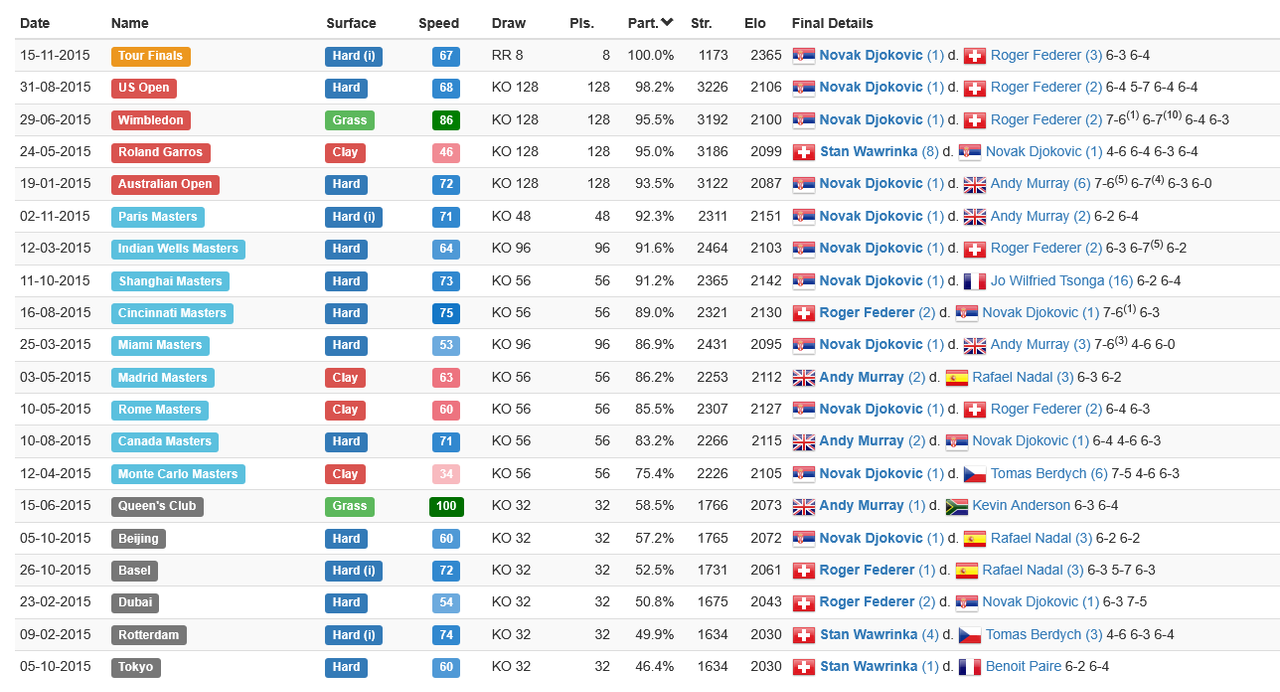
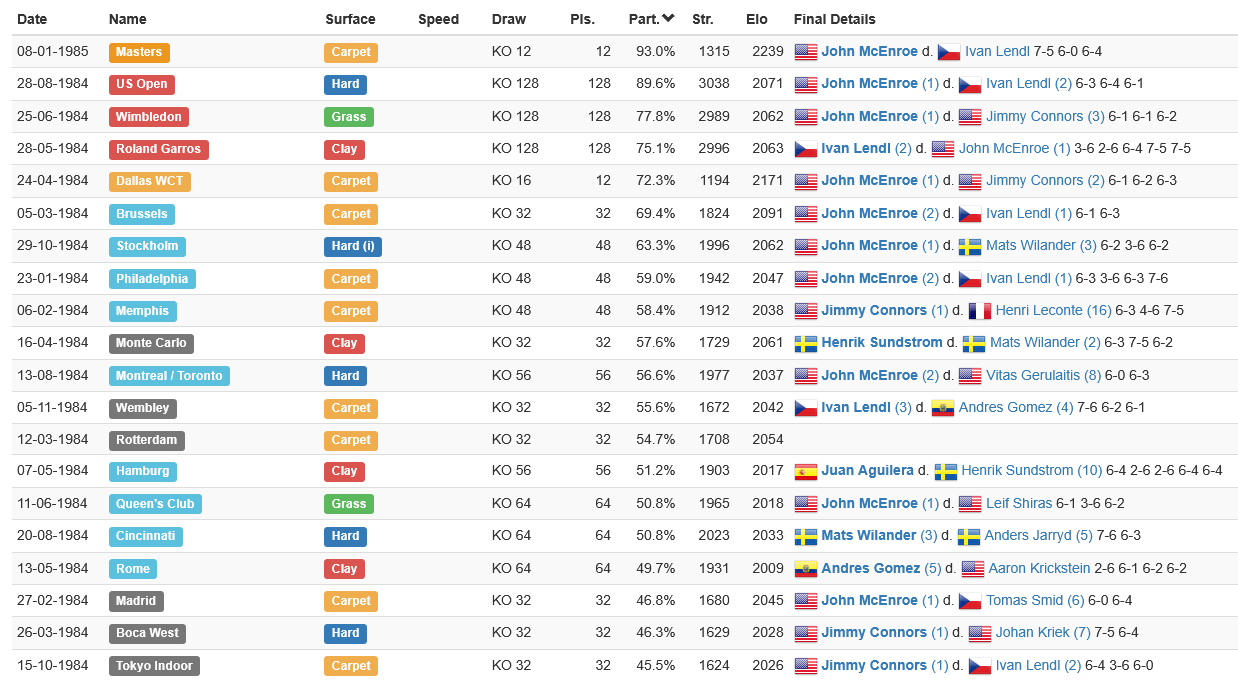
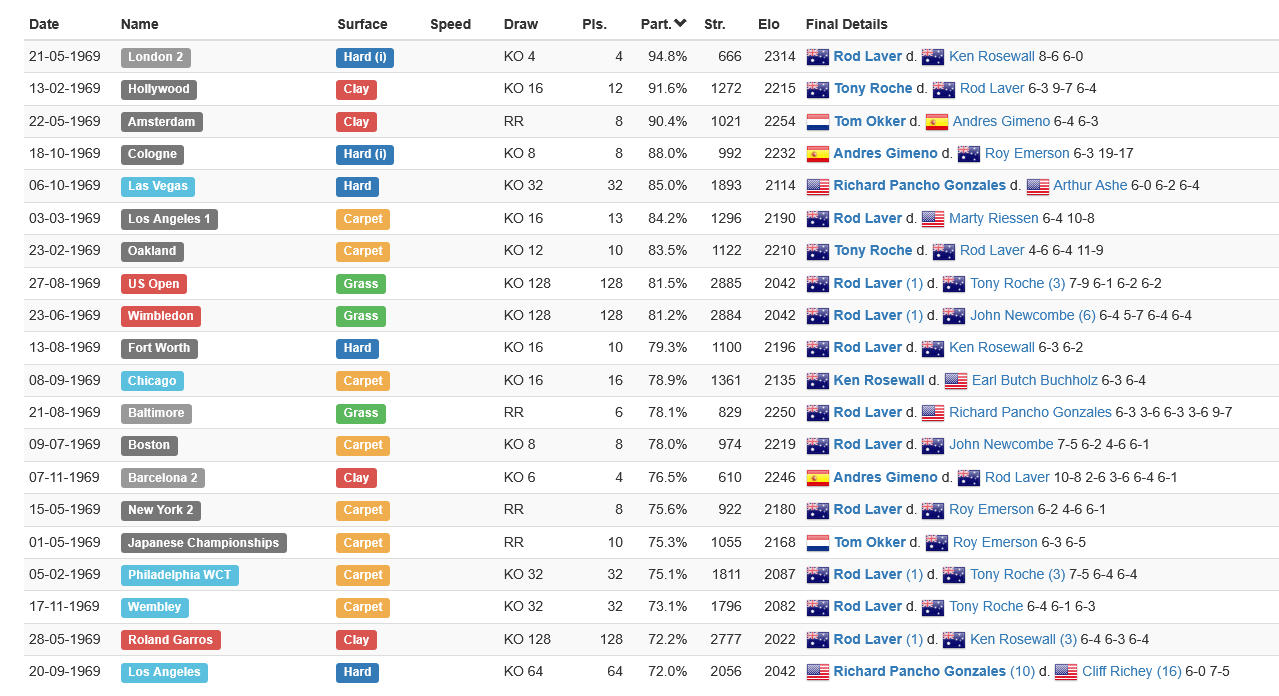
2015 Djokovic 8 titles and 2 finals
1984 McEnroe 7 titles and 1 final
1969 Laver 5 titles and 2 finals
In the top20 tournaments of the year by participation rate:
2015 Djokovic 11 titles and 4 finals
1969 Laver 11 titles and 3 finals
1984 McEnroe 10 titles and 1 final
junkieballer
Legend
Djokovic beat peak #1 and Olympic champion Murray in the 2017 Doha final, that doesn't make it a top4 tournament of the year.My point is that beating a legend or two is way more relevant than what number of lower top ten players participate,, especially if you do not play them anyways. Imagine Murray plays a 128 draw with all the big three in, who however all lose early or retired injured etc, such that Murray can win the slam without facing them (aka what he did in 2016). Then imagine on the other hand a draw with only 64 players in and players ranked 5-20 all missing, but the player who wins the slam beats Nadal in the semi and Fed in the final? Which one would you say is more impressive?
Newcombe beat a peak Connors coming from one of the best years of the OE as well as Tony Roche. Murray beat Cilic, Berdych, Tsonga, Kyrgios. I do think that this more than outweighs 1 more round against players between 50-100.
BorgTheGOAT
G.O.A.T.
Bo5 vs Bo3.Djokovic beat peak #1 and Olympic champion Murray in the 2017 Doha final, that doesn't make it a top4 tournament of the year.
junkieballer
Legend
Jiri Novak beat the Wimbledon champion Federer in the Gstaad Bo5 final. That doesn't make Gstaad one of the top4 tournament of the year.Bo5 vs Bo3.
BorgTheGOAT
G.O.A.T.
You can send me all kind of individual matches/tournaments, fact is, when trying to discredit some of the older AOs one has to look on who the winner actually beat. Beating peak Connors in a Bo5 final of a slam is way more impressive than beating Raonic in a Wimbledon final.Jiri Novak beat the Wimbledon champion Federer in the Gstaad Bo5 final. That doesn't make Gstaad one of the top4 tournament of the year.
BorgTheGOAT
G.O.A.T.
Yes but let's be real here. McEnroe in 1984 was 6-0 against Connors, 6-1 against Lendl and 3-0 against Wilander. Given the level of competition that is GOAT stuff, comparable or even better than Djokovic's 2011 10-1 against Fedal (I only say it could even be equal, since peak Nadal is even a level above Lend/Connors/Mats in 1984).I know that Connors was 31-32 in 1984, while Federer was 33-34 in 2015, but given that it was easier for players to maintain a decent level for longer in 2015 than it had been in 1984, I think they were about equally old in tennis terms in those years (e.g. about equally far from what they had once been).
Djokovic in 2015 was 5-3 against Fed, 6-1 against Murray and 3-1 against Stan. Sorry, but this is not even close to be same.
junkieballer
Legend
winning the tournaments > h2h.Yes but let's be real here. McEnroe in 1984 was 6-0 against Connors, 6-1 against Lendl and 3-0 against Wilander. Given the level of competition that is GOAT stuff, comparable or even better than Djokovic's 2011 10-1 against Fedal (I only say it could even be equal, since peak Nadal is even a level above Lend/Connors/Mats in 1984).
Djokovic in 2015 was 5-3 against Fed, 6-1 against Murray and 3-1 against Stan. Sorry, but this is not even close to be same.
By the way Novak was also 4-0 vs Nadal, and one of Novak's losses to Fed was round robin, Novak took the title.
Last edited:
BorgTheGOAT
G.O.A.T.
Nadal in 2015 is not a player remotely on the level of Connors/Lendl/Mats/Fed/Murray/Wawrinka. No need to mention him here.winning the tournaments > h2h.
By the way Novak was also 4-0 vs Nadal, and one of Novak's losses to Fed was round robin, Novak took the title.
helterskelter
G.O.A.T.
Yes but let's be real here. McEnroe in 1984 was 6-0 against Connors, 6-1 against Lendl and 3-0 against Wilander. Given the level of competition that is GOAT stuff, comparable or even better than Djokovic's 2011 10-1 against Fedal (I only say it could even be equal, since peak Nadal is even a level above Lend/Connors/Mats in 1984).
Djokovic in 2015 was 5-3 against Fed, 6-1 against Murray and 3-1 against Stan. Sorry, but this is not even close to be same.
I was just commenting on you referring to 2015 Federer as "old" but not referring to 1984 Connors as "old."

tennis_pro
Bionic Poster
2015? Nadal in his worst season ever and Fed at 34? And he still lost 3 times to him that year.
2011 is miles better. 2015 was easy pickings.
2011 is miles better. 2015 was easy pickings.
junior74
Bionic Poster
Nadal in 2015 is not a player remotely on the level of Connors/Lendl/Mats/Fed/Murray/Wawrinka. No need to mention him here.
It's a fact that Nadal would have won a lot in 2015 if he didn't lose all the time


RS
Bionic Poster
I used to go 2015 but not sure nowdays.Is the statistical superiority enough to put Djoko 15 over 11? I'm curious, since the value put on the post-USO stretch of the season seems to vary depending who you ask.

BauerAlmeida
Legend
Numbers are important only when it works in our favor .
But he's using numbers to back his point of view...
BorgTheGOAT
G.O.A.T.
Exactly. The guys who beat Pete at RG in many years had wins over the No.1 rank. Guys who beat Muster at Wimbledon could mean they have a top ten win. On the other hand we had top players on certain surfaces especially on grass who were in some years not even seeded (Goran, Rafter etc.).using rankings to rate which event is "stronger" is pretty damn stupid in when it comes to past eras. for example Rusedski was a top 5 seed at '98 RG. Would Moya's RG win be "better" on paper if he beat #5 Rusedski instead of #14 Corretja or #15 Mantilla en route to his win? Or #5 Clerc skipping '82 Wimbledon, if Connors beat him in the semis instead #12 Edmondson would that be a better win?
Based on many threads here over the years, I think a lot of you really do think this.
The whole "pretty much all the top 10 players do well on all surfaces" was not really a thing until the last 20 years or so (gee I wonder why)
junkieballer
Legend
Ok but at least the top players participated to tournaments if the prize money was good, even if they weren't the favourite to win it, that's why I'm taking the participation rate as the main criteria to determine the value of the tournament.Exactly. The guys who beat Pete at RG in many years had wins over the No.1 rank. Guys who beat Muster at Wimbledon could mean they have a top ten win. On the other hand we had top players on certain surfaces especially on grass who were in some years not even seeded (Goran, Rafter etc.).

ALCARAZWON
Hall of Fame
2015 is the ultimate example of Djokovic only being as good as FEDAL allowed him to be.
Nadal played at about 20% his usual level, and everybody cashed in, even Berdych (beat Nadal at the AO, breaking a 17 match losing streak in their H2H).
Even Murray AND Wawrinka beat Nadal in straight sets on clay in 2015.
And despite playing at his worst level, Nadal still came back from a double-break down in the 1st Set to reach 5-5 vs. Djokovic at their 2015 RG match.
The fact 2015 is the peak of Djokovic's career, tells you everything you need to know about how overrated Djokovic is, and how his best was never good enough vs. Peak FEDAL at he US Open and French Open.
2004-2008 Federer is greater than anything Djokovic ever did on hardcourt, grass and clay (Federer had to deal with the most athletic version of Nadal every year at Roland Garros), and obviously Nadal Roland Garros is greater than anything Djokovic ever did, and Nadal's best US Open level is also greater than Peak Djokovic.
And FEDAL on grass 2007-08 is a higher level of tennis than anything Djokovic ever did at Wimbledon, and 10 years later even a much slower version of Nadal came within a whisker of beating Djokovic at 2018 Wimbledon with the roof closed, not to mention 2019 Federer vs. Djokovic.
Last edited:
junkieballer
Legend
2015 Djokovic winning the #1, #2, #3, #5, #6, #7, #8, #10 tournaments with the most top players and reaching the final in #4 and #9 is one of the most impressive achievements that exists for a single season.
He was literally two matches away from winning all the 12 top tournaments from 2014 YEC to 2016 Australian Open.
He was literally two matches away from winning all the 12 top tournaments from 2014 YEC to 2016 Australian Open.
BorgTheGOAT
G.O.A.T.
Whether top player or not was very much surface-dependent. In the 90s we had guys like Muster, Bruguera, Berasategui, Chesnokov who won or were at least contenders at the FO but hardly even reached a second round at Wimbledon. Do you think it would have made a big difference if those guys participated at Wimbledon or not? In 1995 for example both Bruguera and Muster skipped Wimbledon, regardless of prize money. Both of them were top ten player at that time, would you say it was a "weaker" Wimbledon because two top ten players did not participate? Those guys were basically journeymen on grass with zero chance to win or to upset a big name, nevertheless on paper they were top players at that time.Ok but at least the top players participated to tournaments if the prize money was good, even if they weren't the favourite to win It, that's why I'm talking the participation rate as the main criteria to determine the value of the tournament.
But he's using numbers to back his point of view...
CYGS is not a number ?

mike danny
Bionic Poster
I pick 2011 Djokovic any day over 2015. The former was his highest level, not the latter.
The latter was just his most successful season.
The latter was just his most successful season.
insideoutforehanders
Hall of Fame
I pick 2011 Djokovic any day over 2015. The former was his highest level, not the latter.
The latter was just his most successful season.
Well one huge advantage of 2015 is he maintained a very high level the entire year where in 2011 he kind of went away post US Open until years end. The first 8.5 months of 2011 easily over 2015 I agree though, pure level wise.
mike danny
Bionic Poster
In 2011 he went 10-1 over great versions of Fedal.Well one huge advantage of 2015 is he maintained a very high level the entire year where in 2011 he kind of went away post US Open until years end. The first 8.5 months of 2011 easily over 2015 I agree though, pure level wise.
In 2015 he lost to Stan in 4 in a slam final.
To me it’s a no-brainer
Last edited:

Hitman
Bionic Poster
I pick 2011 Djokovic any day over 2015. The former was his highest level, not the latter.
The latter was just his most successful season.
On grass though 2015 was higher

Similar threads
- Replies
- 64
- Views
- 4K


- Replies
- 50
- Views
- 3K
- Replies
- 27
- Views
- 458

- Poll
- Replies
- 9
- Views
- 1K
