Federer Backhand Eurosport Critique

  • Thread starter Thread starter Deleted member 733170
  • Start date Start date
This in essence is the conundrum which is essentially unprovable. On the one hand the top commentators, my coach and their crowd (former top juniors), people who I meet at the club who watch tons of tennis all appear to say that Federer is playing higher quality tennis than he ever has done. I am sympathetic to these opinions.

On the other hand, in the dark recesses of the internet, are a group of posters, incidentally self proclaimed experts, who refuse to acknowledge the very possibility that this could be true.

Where I am sympathetic to the internet experts is that Federer is more prone to tiredness, injury, does not enjoy the day in day out consistency (but he’s not far off) and his defence is not quite as good, however when he’s on he’s frankly better than he ever has been.
so you admit that Djokovic>Federer or that 2017 Federer is somehow miles better than 2015 Federer? Or else, no one can take you seriously.
 
Sure there are. I will show you. Federer “loses” in Dubai, goes on to win the Sunshine Double. Then “loses” in Stuttgart, goes on to win Halle and WB without dropping a set. After being tired from winning Shanghai and Basel, he had enough and “lost” after smoking Goffin 6-2 in the 1st set at WTF.
Nobody is tired of all the winning. If he could have won the WTF he would have tried to.

you just need to face that at 35, 36, he's going to occasionally just unexpectedly lose every now and then, but he'll still have game for the next tournament
 
Nobody is tired of all the winning. If he could have won the WTF he would have tried to.

you just need to face that at 35, 36, he's going to occasionally just unexpectedly lose every now and then, but he'll still have game for the next tournament

Nah. Too much of a coincidence.
 
so you admit that Djokovic>Federer or that 2017 Federer is somehow miles better than 2015 Federer? Or else, no one can take you seriously.

Well clearly Djokovic in 14-16 had the measure of Federer. Yeah I think Federer in 17 was better than in 15. He came back fresh with a better backhand and after his Aussie win he could play without pressure and that bought out the best in him.

I don’t think any of this is particularly controversial, do you?
 
so you admit that Djokovic>Federer or that 2017 Federer is somehow miles better than 2015 Federer? Or else, no one can take you seriously.

Djokovic had the advantage of being younger than Fed and following in his footsteps, so I would indeed not be surprised if he at his best took tennis to a slightly higher level than Fed did at his best in absolute terms. That's how it has gone for pretty much all of tennis history after all. The best players played better in 2005 than in 1995, in 1995 than in 1985 and so on (and if you compare 2005 and 1985, it's not even funny). There may be some short term deviance from the trend line, but over time this tends to hold.

This doesn't mean that Djokovic is greater than Fed. He ain't.
 
This in essence is the conundrum which is essentially unprovable. On the one hand the top commentators, my coach and their crowd (former top juniors), people who I meet at the club who watch tons of tennis all appear to say that Federer is playing higher quality tennis than he ever has done. I am sympathetic to these opinions.

On the other hand, in the dark recesses of the internet, are a group of posters, incidentally self proclaimed experts, who refuse to acknowledge the very possibility that this could be true.

Where I am sympathetic to the internet experts is that Federer is more prone to tiredness, injurdy, does not enjoy the day in day out consistency (but he’s not far off) and his defence is not quite as good, however when he’s on he’s frankly better than he ever has been.

dark recesses of the internet ? yeah, all top secret guys with an agenda.

I mean , its not like there's statistical proof that tennis players peak in their mid 20s :

https://tt.tennis-warehouse.com/ind...ution-of-all-open-era-major-finalists.453446/

(best years are from 22 to 25 in the open era. FEderer's stats line up with that )

areas that he's improved :
serve - marginally, tactically to some extent, BH better than in 2004-05, but on same level as 2006-07.

areas that are worse :
forehand, movement, return, passing shots

yeah, I'd easily take 2004-07 federer.
so would anyone who saw a lot of 2004-07 federer , actually remembers and isn't a bandwagoner that everything at present is the best.

that includes this guy @TheMaestro1990 who actually made this huge compilation of 1000 best shots by Federer.

 
Djokovic had the advantage of being younger than Fed and following in his footsteps, so I would indeed not be surprised if he at his best took tennis to a slightly higher level than Fed did at his best in absolute terms. That's how it has gone for pretty much all of tennis history after all. The best players played better in 2005 than in 1995, in 1995 than in 1985 and so on (and if you compare 2005 and 1985, it's not even funny). There may be some short term deviance from the trend line, but over time this tends to hold.

This doesn't mean that Djokovic is greater than Fed. He ain't.

This is the narrative I have more or less come to accept.
 
Djokovic had the advantage of being younger than Fed and following in his footsteps, so I would indeed not be surprised if he at his best took tennis to a slightly higher level than Fed did at his best in absolute terms. That's how it has gone for pretty much all of tennis history after all. The best players played better in 2005 than in 1995, in 1995 than in 1985 and so on (and if you compare 2005 and 1985, it's not even funny). There may be some short term deviance from the trend line, but over time this tends to hold.

This doesn't mean that Djokovic is greater than Fed. He ain't.
That's a reasonable viewpoint even if I disagree, but my comment was based on the supposed premise that Federer is now playing his best tennis because of improved backhand, and serve, and because the shining glow of fatherhood and meditating in a snowbank in the alps in the 2nd half of 2016 has enlightened him or whatever.
 
Well clearly Djokovic in 14-16 had the measure of Federer. Yeah I think Federer in 17 was better than in 15. He came back fresh with a better backhand and after his Aussie win he could play without pressure and that bought out the best in him.

I don’t think any of this is particularly controversial, do you?
So would 2017 Federer, new and improved over 2015, beat 2015/2016 Djokovic, or is Novak simply a better player peak for peak?
 
dark recesses of the internet ? yeah, all top secret guys with an agenda.

I mean , its not like there's statistical proof that tennis players peak in their mid 20s :

https://tt.tennis-warehouse.com/ind...ution-of-all-open-era-major-finalists.453446/

(best years are from 22 to 25 in the open era. FEderer's stats line up with that )
This is absolutely true.

Recency bias says that the rules have changed, that best year are now close to 30 or even later.

It is possible that this "sweet spot" for winning majors is moving up and may eventually get close to age 30. But we have no proof yet that the aging of winners is permanent of indicative of what it will settle down to be in the next 10 to 15 years.

As I have pointed out frequently, things were very similar right before Connors, Laver winning the GS at close to 31 (He was 31 for the USO), Rosewall winning things even older than Fed.

It's like looking at hurricanes for a couple years and making long-term predictions of how many will hit land and do great damage in the average year. It is likely that we are getting more now, but you can't go by last year. Looking at my area we had no major storms hit between Wilma and the last couple years. Doesn't prove anything about global weather.

Laver, Rosewall and Gonzalez were all freaks of nature. They were not the norm. Fed and Nadal are not either, with Djokovic now a question mark as to longevity. Lots of older guys winning minor events, but not majors.
 
he has a weakness on his forehand side, but you know a player is playing well when he makes it virtually impossible for his opponent to even have a chance to exploit said weakness, i have been saying for more than a year now that if nadal wants to defeat him he has to play more crosscourt with his backhand, there you have an example but as you can see, not even rafa gets a chance very often to go there as he is spending more time retrieving feds attacks, just like most other players last year
 
That's a reasonable viewpoint even if I disagree, but my comment was based on the supposed premise that Federer is now playing his best tennis because of improved backhand, and serve, and because the shining glow of fatherhood and meditating in a snowbank in the alps in the 2nd half of 2016 has enlightened him or whatever.
I'd say this: every ATG goes on improving in knowledge/tactics for as long as they play. A great deal of this is about competition. If Fed, now, had the same body he had at age 23-24, I'd expect him to be a better player. I'd say about every ATG who has ever played, provided they continued to compete and kept their hunger to win.

This at all times has to be balanced against physical decline, which is inevitable even if the progression is a bit different for each person.

I think we make assumptions about improvement in technique that are not supported by facts.

I was just looking at Steven Denton serving against McEnroe in the early 80s. I'd challenge anyone to find a more impressive looking serve today. But there are changes in stats due to rackets and strings. Top players then aced as frequently as they do today, but the DFed a lot more. We could conclude that everyone serves better today, but more likely it "is what it is" based on the available technology.

Even comparing Sampras against Fed is unfair re serving, because when you compare stats between these two eras, they've changed. Players today aren't winning more games. They are winning more service games, fewer return games, but ATGs are winning the same % of all games.

I'd say part of the "balance of power" between 2006 and 2017 is purely equipment. Fed's equipment is better now. Not as radical as giving Sampras in the 90s poly, but in that direction. Was Sampras a lesser player because he did not play with poly?

My opinion: No!
 
Fed's BH improvement has meant he can adopt a more aggressive, balanced court position where the declined movement is less exposed, with much less running around the FH (a lesson for Rafa?). His judgment of a good approach shot has also improved markedly after the SABR period so he now has noticeably more options to shorten points.

Either way, I hope Djoko goes close to regaining his peak and Fed can retain his 2017 level for a few matches to give us an idea of where this argument is at.

On the one hand the top commentators, my coach and their crowd (former top juniors), people who I meet at the club who watch tons of tennis all appear to say that Federer is playing higher quality tennis than he ever has done. I am sympathetic to these opinions.

On the other hand, in the dark recesses of the internet, are a group of posters, incidentally self proclaimed experts, who refuse to acknowledge the very possibility that this could be true.

Good posts by you and Sysyphus ITT and this is my almost exact same experience with this topic too. It's a bit bemusing to see such stridency on the other side of this argument.

1.His movement is at least 15% off peak level.
2. His movement to his FH corner is off 25% from peak level.
3. He can't play a full schedule anymore
4. Even with a paltry 2017 schedule he was mentally/physically done in by the YEC

Fed won 3/4 slams three times in his career. If he's "playing better than ever," why didn't he replicate this feat in 2017?

I think your estimates are at least 10% too high for both points 1 & 2. Nobody is saying he can string seasons together like his 3-slam-near-3-peat peak, merely we're seeking comparison between previous levels, including the prime peak levels with his peak 2017 levels. Admittedly, that was less than half the 2017 season, but there was enough of it to warrant discussion.

As a fellow member of Team Nick, surely you can distinguish between talent/game and consistency of results that comes with fitness and motivation?
 
I'd say this: every ATG goes on improving in knowledge/tactics for as long as they play. A great deal of this is about competition. If Fed, now, had the same body he had at age 23-24, I'd expect him to be a better player. I'd say about every ATG who has ever played, provided they continued to compete and kept their hunger to win.

This at all times has to be balanced against physical decline, which is inevitable even if the progression is a bit different for each person.

I think we make assumptions about improvement in technique that are not supported by facts.

I was just looking at Steven Denton serving against McEnroe in the early 80s. I'd challenge anyone to find a more impressive looking serve today. But there are changes in stats due to rackets and strings. Top players then aced as frequently as they do today, but the DFed a lot more. We could conclude that everyone serves better today, but more likely it "is what it is" based on the available technology.

Even comparing Sampras against Fed is unfair re serving, because when you compare stats between these two eras, they've changed. Players today aren't winning more games. They are winning more service games, fewer return games, but ATGs are winning the same % of all games.

I'd say part of the "balance of power" between 2006 and 2017 is purely equipment. Fed's equipment is better now. Not as radical as giving Sampras in the 90s poly, but in that direction. Was Sampras a lesser player because he did not play with poly?

My opinion: No!
First of all it is very debatable that a bigger racket makes peak Federer a better player given that he had the tools(footwork) to fully maximize the advantages of a 90, and that is what he built his game around. A bigger racket likely helps him on clay, but would be at risk of negatively impacting his game on faster surfaces, at least in the way that he played at his peak. Either way, the difference in technology is far less pronounced than the change from gut to poly or wood to graphite. Pretty sure Federer still uses the same gut/big banger strings today too, although perhaps there are minute differences, I am not an expert on strings. Speaking from experience, I really don't see much difference in the mid 00's pro hurricane tour/big banger to today's RPM blast and what not.

He is a smarter player today, but the physical differences are too much to reconcile. But peak Fed was damn smart as well in how he played although he could afford to be less efficient. Honestly his "dumbest" moments came later when he didn't quite have the movement to continue playing his peak game style but stuck with it.
 
First of all it is very debatable that a bigger racket makes peak Federer a better player given that he had the tools(footwork) to fully maximize the advantages of a 90, and that is what he built his game around. A bigger racket likely helps him on clay, but would be at risk of negatively impacting his game on faster surfaces, at least in the way that he played at his peak.
I would not debate this because we're in the Fact Free Zone. That's true of me as much as anyone.

I would be interested in what Fed would say though. Would he think today he would play better with the old 90, if he could have his youth back, speed, etc.?

But in general there continues to be changes in stats that reflect the tech, and this has gone on since the beginning of the OE. I think it reflects technology.

I mentioned earlier that the top guys in the 80s hit aces about as often as they do today, if you throw out the freaks, Isner and Karlovic. Steve Denton may have hit more aces per game than Raonic, and he was only 6'2".

Yet those guys ALL DFed way more than modern players, and the 90s players DFed more often than this era. Sampras DFed more than Fed, a lot more. You can say it was his tactics, or his game style, but this is an across the board stat, and it has to be equipment. At least I think that's what it is.

Of course playing with this racket would change his game, at his peak, but we are talking about one of the most incredibly talented and adaptive athletes of all time. We don't know what Fed would have looked like, starting with the racket he now has. But it's reasonable to assume he would have done just fine, and the thought of Fed better on clay is a fascinating idea. ;)
 
Honestly.... and seriously... I absolutely 100% mean this...

Only in tennis and on a tennis forum would people ever claim a 37 year old athlete is at his peak... this is borderline hilarious lol.
 
Yet those guys ALL DFed way more than modern players, and the 90s players DFed more often than this era. Sampras DFed more than Fed, a lot more. You can say it was his tactics, or his game style, but this is an across the board stat, and it has to be equipment. At least I think that's what it is.

This is a very interesting point. First of all, it would be nice to see some stats here, but even going on this premise, does double-faulting necessarily indicate equipment?

Off the top of my head, I can think of serve as far more important in the 90s and earlier to win points because the surfaces were not as slow and one could not hope to recover a point from the baseline once the point started unfavorably; in other words, servers took more risk for a potentially big reward. I bet the stats reflect that too if you're going to compare DF rates: that more points were won on aces and service winners back then.

Of course it would follow that if more risk was being taken on serve, then the DF rate would indicate that.

Just anecdotally, I would say that slower surfaces allowing for baseline domination accounts for more than racket tech.

The only caveat is string technology (regardless of head size) and that is a whole different story.
 
So would 2017 Federer, new and improved over 2015, beat 2015/2016 Djokovic, or is Novak simply a better player peak for peak?

I honestly don’t know. It’s a fair hypothetical to ponder over. Confidence would be the determining factor I think.
 
Honestly.... and seriously... I absolutely 100% mean this...

Only in tennis and on a tennis forum would people ever claim a 37 year old athlete is at his peak... this is borderline hilarious lol.

The Federer in the match that's being analyzed was 35. The Federer of today is 36. Only on a tennis forum would people some how turn this into 37?

Anyways, this argument comes up often, and I find the dogmatism in it to be very curious. It's not unheard of at all to see athletes perform personal bests well into their 30s in several sports that are far more purely physical in nature than tennis. It certainly happens. Tennis is on the other hand a largely skill-based sports, which means that there are plenty of things to improve and compensate with after the body has passed its apex. The rate of evolution in general in such skill based sports also tends to be steeper than in simpler sports where there are fewer variables to improve upon. (and performance still tends to improve over time in such sports as well.)

Name one athlete in a physical sport that performed best, broke records or had personal best season at the age of 36 lol, chess is not a sport.
 
2017 Federer is peak Federer outside clay. I would take 2017 Federer on grass or HC over 2004-2009 Federer any day. Federer's classical backhand was his biggest weakness. His biggest weakness in 2017 was the lower stamina and speed. He should give it a try to the FO 2018!
 
And what could cause one player to be more confident rather than the other?

Recent results in the head to head, momentum, crowd pressure and expectation etc. In other words intangibles, which are far more to difficult to measure than speed of backhand and other statistics, which are themselves subject to non perfect conditions of measurement.
 
This is the narrative I have more or less come to accept.

The thing that saddens me a bit when this topic comes up isn't that people still believe Fed played better tennis 10+ years ago. They could absolutely be right, there's no way to really determine.

The sad thing to me is instead how blind faith trumps any concrete evidence. While the video you posted obviously doesn't prove that Fed plays better now than ever, it does evidence several things Fed did indeed improve. Firstly, it shows actual data that shows that Fed's median backhand speed got slightly higher in 2014 than 2012 after he changed his racquet, and then drastically higher in 2017 with his revamped technique – all against the same opponent. It also demonstrates that he changed his court positioning, to increased success against said player. And it also illustrates the manner in which his technique changed to become more efficient on this shot.

I hardly ever see any such concrete evidence for all the fantastical claims to the contrary. Data like what you shared is often met with claims like, "well, it's just because Nadal sucks so bad now," with no concrete evidence of how Nadal is so much worse. And if you say that statistically speaking Nadal is actually still incredibly good, you'll hear, "well, that's just because the entire field is playing much worse," which again is the type of claim that can't really be demonstrated.

Instead, claims to the contrary are typically based on blind faith, leveled with remarkable certainty and chutzpah. The proof is subjective judgement that you're blind if you don't share.
 
This doesn't necessarily tell us that much. It could simply be that Federer is slicing less thus hitting with more kmph on average. Hitting his backhand harder on average than in 2012 doesn't mean he's hitting it harder than say 04-07 either. He was hitting his backhand slightly faster in 2014 compared to 2012 as well - despite 2012 being a clearly higher level of play IMO.

Mentioning what Federer was doing off the backhand side at the AO in 2013 on a much slower court is a bit of a blunder from Eurosport as well.

As far as the SABR goes I think it's something Federer just started doing in practice, not sure he actually had to train and significantly enhance his footwork to pull it off...
The weakeraerer agenda shines through.:cool:

Without a doubt Federer is in decline. He won't even set foot on clay anymore and one can see a slow erosion in his hard court first serve stats from 2015, but still better than his "peak" from 2004-2007. However, despite some decline on return (especially first return), Federer's 2nd return is significantly better than 2012 and 2015.

The improvement from 2017 is pretty obviously backhand driven. A player of Federer's age should be seeing big time decline on his 2nd serve and 2nd return numbers. The 2nd return is better than 2015 and on par with his post peak numbers. This is all the more amazing when you consider that Fed has been pretty physically skittish at a lot of events in 2017 in comparison to 2015. The 2nd serve numbers are a joke in 2017, simply unbelievably improved on hard courts and in line with Fed's peak years from 2004-2007. Maybe Fed has a vastly improved his 2nd serve and movement and maybe unicorns exist.:rolleyes: The backhand change is the obvious answer on so many levels that only the most ardent Frauderista would say otherwise.;)

I'd highlight the backhand return specifically for the biggest improvement.
 
The thing that saddens me a bit when this topic comes up isn't that people still believe Fed played better tennis 10+ years ago. They could absolutely be right, there's no way to really determine.

The sad thing to me is instead how blind faith trumps any concrete evidence. While the video you posted obviously doesn't prove that Fed plays better now than ever, it does evidence several things Fed did indeed improve. Firstly, it shows actual data that shows that Fed's median backhand speed got slightly higher in 2014 than 2012 after he changed his racquet, and then drastically higher in 2017 with his revamped technique – all against the same opponent. It also demonstrates that he changed his court positioning, to increased success against said player. And it also illustrates the manner in which his technique changed to become more efficient on this shot.

I hardly ever see any such concrete evidence for all the fantastical claims to the contrary. Data like what you shared is often met with claims like, "well, it's just because Nadal sucks so bad now," with no concrete evidence of how Nadal is so much worse. And if you say that statistically speaking Nadal is actually still incredibly good, you'll hear, "well, that's just because the entire field is playing much worse," which again is the type of claim that can't really be demonstrated.

Instead, claims to the contrary are typically based on blind faith, leveled with remarkable certainty and chutzpah. The proof is subjective judgement that you're blind if you don't share.

except no one is really saying fed of 14 is better than fed in 17.
12 vs 17 is debatable.

everyone who's followed tennis knows fed's BH in 17 is better than that in 12 and 14.

the comparision is supposedly b/w fed of 17 and from 2004-07 at his peak when saying federer is better now than ever.

so the video is near useless when talking about that.
 
Name one athlete in a physical sport that performed best, broke records or had personal best season at the age of 36 lol, chess is not a sport.
Peyton Manning in American Football(and a few other QBs), quite a few people in baseball. Michael Jordan probably still would have averaged near 30 ppg and be best player in the league if he played in '99.

Either way, 26 yo Fed is definitely better than 36 yo Fed imo, just pointing out examples.
 
except no one is really saying fed of 14 is better than fed in 17.
12 vs 17 is debatable.

everyone who's followed tennis knows fed's BH in 17 is better than that in 12 and 14.

the comparision is supposedly b/w fed of 17 and from 2004-07 at his peak when saying federer is better now than ever.

so the video is near useless when talking about that.

For all practical purposes, you're proving my point in that post.
 
That would be a great objection — if it was a figure of his average speed. But it's not, it's median speed. And his median backhand then and now is surely a drive. So I don't see how some fewer slices would explain this gap.

Moreover, surely it's enough to just use our eyes? He clearly hit his backhand drives with more interest in the 2017 final, nay?
dumb question but just to be sure, I understand this right.
Average BH speed = every backhand he hits.
Median BH speed = the average speed of every backhand turned into a specific number which then is a drive?
Sorry, confused (and drunk/tipsy)
 
The thing that saddens me a bit when this topic comes up isn't that people still believe Fed played better tennis 10+ years ago. They could absolutely be right, there's no way to really determine.

The sad thing to me is instead how blind faith trumps any concrete evidence. While the video you posted obviously doesn't prove that Fed plays better now than ever, it does evidence several things Fed did indeed improve. Firstly, it shows actual data that shows that Fed's median backhand speed got slightly higher in 2014 than 2012 after he changed his racquet, and then drastically higher in 2017 with his revamped technique – all against the same opponent. It also demonstrates that he changed his court positioning, to increased success against said player. And it also illustrates the manner in which his technique changed to become more efficient on this shot.

I hardly ever see any such concrete evidence for all the fantastical claims to the contrary. Data like what you shared is often met with claims like, "well, it's just because Nadal sucks so bad now," with no concrete evidence of how Nadal is so much worse. And if you say that statistically speaking Nadal is actually still incredibly good, you'll hear, "well, that's just because the entire field is playing much worse," which again is the type of claim that can't really be demonstrated.

Instead, claims to the contrary are typically based on blind faith, leveled with remarkable certainty and chutzpah. The proof is subjective judgement that you're blind if you don't share.

Yes indeed, the problem in my view can be distilled down to the fact that a number of Federer fans have been so bamboozled by Nadal fans over the weak era discussion and h2h that they mythologised 2006 Fed as the apotheosis of a tennis being.

I’ve seen it all on this forum. It’s become a place of fundamentalists and evolution deniers. Just check out the Fed Sampras match. He hardly jumps up on the serve. Looks at the volleys in that match and those he made when he won Wimbledon in 2003 and then go and look at the volleys he made against Wawrinka at Indian Wells this year. It’s a different game. Murray and even Berdych make Safin and Philipppoussis look like dilettantes.
 
For all practical purposes, you're proving my point in that post.

Wrong.

"I hardly ever see any such concrete evidence for all the fantastical claims to the contrary."

Now, show me some places where people say Fed's BH in 2012 or 2014 was better than it has been in 2017.

---

I could show another statistical analysis to show the difference b/w Fed's BH in AO 17 was better than that in AO 12/AO 14/AO 09 vs Nadal.

http://www.tennisabstract.com/blog/2017/01/30/the-federer-backhand-that-finally-beat-nadal/

Its good to have stats to back up claims, but in this case, its not really necessary.

I have lot more data than you can think, but in this case, its not really necessary to show and post everything.

---

And like I said

the comparision is supposedly b/w fed of 17 and from 2004-07 at his peak when saying federer is better now than ever.

so the video is near useless when talking about that.
 
dumb question but just to be sure, I understand this right.
Average BH speed = every backhand he hits.
Median BH speed = the average speed of every backhand turned into a specific number which then is a drive?
Sorry, confused (and drunk/tipsy)

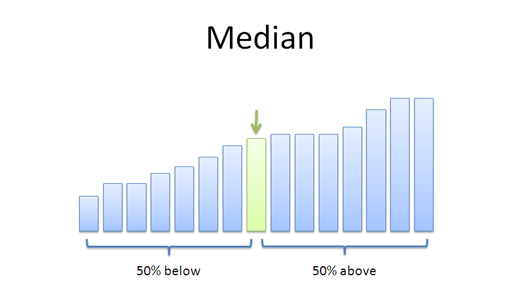
median is the value that falls perfectly in the middle of a sample. Like here:

median.png


It's a better measure than the average in cases like with the backhand speed because it isn't skewed by extreme values on either side. If Fed hits some more extremely slow slices in one of the years, that would affect the average. But the median shouldn't be affected much by this, as it would just represent his most 'typical' shot, if that makes sense.
 
Yes indeed, the problem in my view can be distilled down to the fact that a number of Federer fans have been so bamboozled by Nadal fans over the weak era discussion and h2h that they mythologised 2006 Fed as the apotheosis of a tennis being.

I’ve seen it all on this forum. It’s become a place of fundamentalists and evolution deniers. Just check out the Fed Sampras match. He hardly jumps up on the serve. Looks at the volleys in that match and those he made when he won Wimbledon in 2003 and then go and look at the volleys he made against Wawrinka at Indian Wells this year. It’s a different game. Murray and even Berdych make Safin and Philipppoussis look like dilettantes.

giphy.gif
 
Peyton Manning in American Football(and a few other QBs), quite a few people in baseball. Michael Jordan probably still would have averaged near 30 ppg and be best player in the league if he played in '99.

Either way, 26 yo Fed is definitely better than 36 yo Fed imo, just pointing out examples.

Just because someone is nr1 in the world doesn't mean he is at peak, MJ was at peak in the 1992-1993 period, one has to simply look at the highlights and the pure numbers.
 
So would 2017 Federer, new and improved over 2015, beat 2015/2016 Djokovic, or is Novak simply a better player peak for peak?
We may soon have a better idea if Djokovic finds a semblance of his Peakovic form. If Fed handles this Nole easily in 2018 then pretty good chance Fed 2017 would have the advantage.

Faster courts at WTF and Auz also a huge factor in such an evaluation, both making new Fed much more competitive. A great question and hopefully Djokovic's elbow allows a return to form. Nole looks quite vigorous otherwise.:D
 
Yes indeed, the problem in my view can be distilled down to the fact that a number of Federer fans have been so bamboozled by Nadal fans over the weak era discussion and h2h that they mythologised 2006 Fed as the apotheosis of a tennis being.

I’ve seen it all on this forum. It’s become a place of fundamentalists and evolution deniers. Just check out the Fed Sampras match. He hardly jumps up on the serve. Looks at the volleys in that match and those he made when he won Wimbledon in 2003 and then go and look at the volleys he made against Wawrinka at Indian Wells this year. It’s a different game. Murray and even Berdych make Safin and Philipppoussis look like dilettantes.
:rolleyes::confused: That's beyond harsh.
 
@YetAnotherFedFan :

Now, lets blow apart some of your claims , shall we :

1. Here's a thread started by me on comparision b/w Fed of 15 and 17 :

https://tt.tennis-warehouse.com/ind...015-comparision-of-components-of-game.585744/

Maybe, maybe, just maybe some people have followed Fed's game (or game in general) for longer than you and have a better idea than "everything new is da best".

2. Here's a list of unreturned serve% for Federer :

https://tt.tennis-warehouse.com/ind...rves-of-all-time.306579/page-23#post-10525077

The highest we've got so far is *drumroll* that Sampras match in 2001.

2001 Wim 4R d Sampras - 89/181 (49.2%)
2003 YEC SF d Roddick - 26/56 (46.4%)
2003 Wim F d Philippoussis - 43/93 (46.2%)
2009 Wim F d Roddick - 88/197 (44.7%)
2012 Wim SF d Djokovic - 44/101 (43.6%)
2005 USO F d Agassi - 44/107 (41.1%)
2007 YEC SF d Nadal - 21/48 (43.8%)

https://tt.tennis-warehouse.com/ind...rves-of-all-time.306579/page-23#post-10525077

Wim 05 final : 29/79 (36.71%)
Wim 03 SF : 34/84 (40.48%)

https://tt.tennis-warehouse.com/ind...ddick-wimbledon-2005-final-statistics.607371/

https://tt.tennis-warehouse.com/index.php?threads/federer-roddick-wimbledon-2003-semi-stats.597325/

Yes, SnVing that much increases unreturned serve% to some extent, but Federer didn't even get to that much vs Roddick/Phillippoussis in Wim 03 when he was unbroken in both matches.
 
Last edited:
@YetAnotherFedFan :

Now, lets blow apart some of your claims , shall we :

1. Here's a thread started by me on comparision b/w Fed of 15 and 17 :

https://tt.tennis-warehouse.com/ind...015-comparision-of-components-of-game.585744/

Maybe, maybe, just maybe some people have followed Fed's game (or game in general) for longer than you and have a better idea than "everything new is da best".

2. Here's a list of unreturned serve% for Federer :

https://tt.tennis-warehouse.com/ind...rves-of-all-time.306579/page-23#post-10525077

The highest we've got so far is *drumroll* that Sampras match in 2001.

2001 Wim 4R d Sampras - 89/181 (49.2%)
2003 YEC SF d Roddick - 26/56 (46.4%)
2003 Wim F d Philippoussis - 43/93 (46.2%)
2009 Wim F d Roddick - 88/197 (44.7%)
2012 Wim SF d Djokovic - 44/101 (43.6%)
2005 USO F d Agassi - 44/107 (41.1%)
2007 YEC SF d Nadal - 21/48 (43.8%)

https://tt.tennis-warehouse.com/ind...rves-of-all-time.306579/page-23#post-10525077

Yes, SnVing that much, increases unreturned serve% to some extent, but Federer didn't even get to that much vs Roddick/Phillippoussis in Wim 03 when he was unbroken in both matches.

You need to be clearer as it appears in the first link you are agreeing with me. As to the apparent statistical anomaly in 2001, might court speed be the obvious explanatory factor?
 
Wrong.

"I hardly ever see any such concrete evidence for all the fantastical claims to the contrary."

Now, show me some places where people say Fed's BH in 2012 or 2014 was better than it has been in 2017.

---

I could show another statistical analysis to show the difference b/w Fed's BH in AO 17 was better than that in AO 12/AO 14/AO 09 vs Nadal.

http://www.tennisabstract.com/blog/2017/01/30/the-federer-backhand-that-finally-beat-nadal/

Its good to have stats to back up claims, but in this case, its not really necessary.

I have lot more data than you can think, but in this case, its not really necessary to show and post everything.

---

And like I said

the comparision is supposedly b/w fed of 17 and from 2004-07 at his peak when saying federer is better now than ever.

so the video is near useless when talking about that.

You're apparently not even trying to understand what you're actually responding to, which makes any exchange of opinion quite meaningless. No offense.
 
Wrong.

"I hardly ever see any such concrete evidence for all the fantastical claims to the contrary."

Now, show me some places where people say Fed's BH in 2012 or 2014 was better than it has been in 2017.

---

I could show another statistical analysis to show the difference b/w Fed's BH in AO 17 was better than that in AO 12/AO 14/AO 09 vs Nadal.

http://www.tennisabstract.com/blog/2017/01/30/the-federer-backhand-that-finally-beat-nadal/

Its good to have stats to back up claims, but in this case, its not really necessary.

I have lot more data than you can think, but in this case, its not really necessary to show and post everything.

---

And like I said

the comparision is supposedly b/w fed of 17 and from 2004-07 at his peak when saying federer is better now than ever.

so the video is near useless when talking about that.
One thing that has been going on and now is becoming clearly apparent is the relative weakness of the "Lost Generation" of players currently age 26-29. The impact of this weakness is that the Big 5 have been competing with their fellow geriatrics for the most part and not against younger and faster players.

That is going to change big time in 2018 as all the familiar pigeons are in decline and its not LostGen coming in to fill the holes, its players currently 25 and under. 2018 Auz Open has a wildly unbalanced draw with Fedal largely free and clear of these younger players, but that won't hold for the rest of 2018.

Fed may destroy all of the younger players in 2018 and then we'll have an idea how much ultimate speed really matters. If Fed gets troubled by these quicker, younger players in 2018 we start to get another picture of how the new Backhanderer compares with peak Fed from 2004-2007.
 
Just because someone is nr1 in the world doesn't mean he is at peak, MJ was at peak in the 1992-1993 period, one has to simply look at the highlights and the pure numbers.
I thought you meant best as in best in the league/tour/w.e. Fair enough there. For personal bests though, Peyton Manning had the best season a QB ever had at I think 36/37 and Randy Johnson was pretty much at his peak for a few years past 35.
 
You need to be clearer as it appears in the first link you are agreeing with me. As to the apparent statistical anomaly in 2001, might court speed be the obvious explanatory factor?
2001 is basically wool pants era stuff because Poly strings had not taken hold on the main tour (clay courters used Poly heavily at that point).
 
You need to be clearer as it appears in the first link you are agreeing with me. As to the apparent statistical anomaly in 2001, might court speed be the obvious explanatory factor?

no, the first point is to show that others (who say fed in 04-07 was clearly better than 17 fed) are not blind to the changes in Federer's game.
Hence, know the difference b/w 2015 and 2017. (as well as b/w 2004-07 fed to 2017 fed -- well enough to know that 04-07 fed was clearly better overall)

-------

Even with the faster grass in 01, you need to be serving really well to hit close to a 50% unreturned serves, you know ?
I didn't say it was his best serving performance, just saying that it was an excellent one.

Respectfully these arguments relying on out of context third party comments come across as convoluted non sequiturs.

For your own curiosity have a look at the service action of Federer in 2001. It’s much less dynamic than what it later morphed into.
 
The Federer in the match that's being analyzed was 35. The Federer of today is 36. Only on a tennis forum would people some how turn this into 37?

Anyways, this argument comes up often, and I find the dogmatism in it to be very curious. It's not unheard of at all to see athletes perform personal bests well into their 30s in several sports that are far more purely physical in nature than tennis. It certainly happens. Tennis is on the other hand a largely skill-based sports, which means that there are plenty of things to improve and compensate with after the body has passed its apex. The rate of evolution in general in such skill based sports also tends to be steeper than in simpler sports where there are fewer variables to improve upon. (and performance still tends to improve over time in such sports as well.)

All inductive logic points to the very likely truth in the proposition that tennis has evolved, the extent of which is difficult to measure, especially because of more somewhat (not entirely) extrinsic factors which may merely change rather than improve or evolve the overall aggregate of tennis skill, illuminating some elements and casting shadows on others, thus altering the identity of tennis. It's difficult to then assign reason for things happening because all these variables can be used to bolster pretty much any argument and can't be obviously reduced concretely. However, given the extensive proof and appropriate analogues we have from a myriad of sport, it's a good bet to believe that regardless of all the other stuff in the mix that globally or essentially tennis has evolved as well as changed and will continue to do so. The questions then might be: to what extent is the game fundamentally better (meaning some sort of higher pure aggregate of tennis skill) and after what period of time from 2017 to the past (the current era is the topic of discussion) does that gradual and inexorable evolution create a chasm which but for rare occasions would not be usurped by the much more volatile boundaries of absolute level which can be observed on a match-to-match basis? So, at what point does the global evolution hitherto entirely swamp the potential of form on the day.

I'm of the opinion that the players of 10-15 years ago would often overcome the threshold due to form on the day, though the battle overall against the 2018 collective would be lost. The steady evolution and assimilation of tennis tactics brought about largely through string and racket changes of standard probably provides a significant edge in understanding for the 2018 collective beyond the relatively nascent state of assimilation achieved with the new toys in the earlier 2000s. The biggest cause of the changing identity might be in the strings which, if true, gives stronger grounds for arguing that the... internal(?) identity of tennis in the discussed period is stable enough so that it's reasonable to route the change through improving standard of play rather than the byproduct of parameters the players do not more directly control and wield (the argument would be weaker if surface changes is posited as the main determining factor).

Judgements on absolute level remain relative under the assumption that the fundamental frames of reference change, which happen to lead to higher or lower levels of performance within the structure; given that these trends tend to one direction though, despite this being a pitfall for the cohesion of the argument, it doesn't render the assertions of continued evolution (improvement) irrelevant.
 
Last edited:
You're apparently not even trying to understand what you're actually responding to, which makes any exchange of opinion quite meaningless. No offense.

I understand what you are trying to say. But you're not getting what I'm saying.

What you said is not applicable in the case of this video as comparision is b/w 12/14 and 17 federer at the AO.
I doubt you'd find even a few people saying fed's BH in 12 or 14 was better than in 17.

The video is valid , it shows the difference in BH speed and technique with the new racquet.
But no one is going on actually denying that evidence here.

and yes, Nadal's FH and movement decline is also a factor. He doesn't suck, but they have declined. Its not the only factor, but a factor nonetheless.
To get the 'proof' for that ,

forehand :
a) you need to get the stats for : no of winners hit from the FH, no of errors forced by the FH and no of unforced errors from the FH.
for matches across all seasons.
Yeah, good luck with that.

Many a times, the eye test does show things correctly.

For instance,me and NN over here caught Federer's improvement on the FH right away (compared to 2014-16) :
(Nishikori match at the AO):

Federer's forehand, though.

true ....can't remember the last time it was this good ....some time in 2012 ?

Pretty sure that's the best it's been with his current stick, and yeah I'd say since 2012. He had supreme control on the forehand for a lot of 2012, but he perhaps took it early better here. If we compared this performance to his best 2012 performances, we might be saying he did better today so maybe we could go even further back .. but at least 2012. He is way way weaker on defence on the BH side though. He did make many truly superb forehands on the run and the on the stretch tonight. Also, his timing on the forehand return off slower serves was really good and he was very aggressive with it, which isn't so typical for Fed. Sometimes he adjusted his timing slightly mid swing and still smacked a winner.. like he was waiting on the ball longer.

yeah, the best it has been with the current stick...

I might putsome of performances of 2012 FH on par/a bit over this, but would have to revisit tbh ...

-----------

Now, if you have some concrete evidence to show otherwise, I'll check/listen.

But there isn't any concrete evidence to show that Federer's FH in 17 is up there with his FH from 2004-07 or his movement or his returning (well , actually return stats clearly show his return was better in 04-07).

serve is a tad better, tactics better to some extent and topspin BH is better. But that's not enough to compensate for the other things mentioned above.

I'll go with the eye test/observations, until then.
 
Last edited:
Recent results in the head to head, momentum, crowd pressure and expectation etc. In other words intangibles, which are far more to difficult to measure than speed of backhand and other statistics, which are themselves subject to non perfect conditions of measurement.
Which all time great player at his peak has less than high confidence?

Let's take, say, the 2015 US Open final. Do you think Federer, supposedly close to his peak if not at it, was confident in that match? If not, why? Is it related to these external factors or is it something else?
 
Last edited:
Back
Top