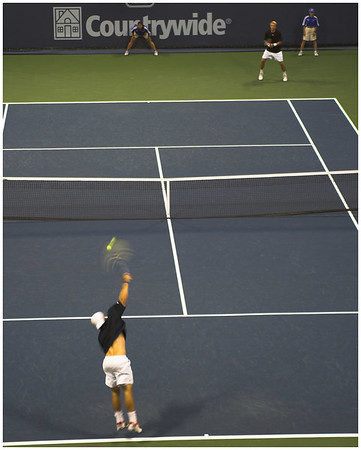
five flat serves (100mph+). Feedback appreciated

spacediver

Hall of Fame
Here is my latest form. The snapshots are from the fourth serve (which sounded the fastest).

https://vimeo.com/48343328

My own observations:

* my tossing arm and hitting arm are staggered. I think I have better results when I raise them together, but at least my hitting arm structure seems properly configured when it counts (6th image).

* something weird going on with my knees - they're coming together during the upward thrust instead of remaining parallel. Not sure if this is a cause for concern.

* I might be prematurely extending my elbow before contact.

I'm guessing the faster serves were between 110 and 120 mph - this estimate is based on me having measured a practice serve a couple years back (it measured 106-107 mph). The current serves in this video feel, sound, and look quite a bit faster than the one I measured.

Any feedback, positive or critical, is welcomed.

Thanks!


23s63xj.png
 
Last edited:
Could be into the 110's.
You could try pronating more to add some extra, without taking the toll on your arm.
Notice on the finish of your followthru, you have more pronating to go if you want.
How consistent are you, with no pressure. Should be at least 60%, since pressure drops your percentages by half.
 
Interesting way to look at it...
launch position looks pretty good as the feet come off the ground.
 
Point of contact is too low and too far to the right of your body and sometimes a few inches behind your head. You pronate too early which leads to a semi "pancake serve" where you flex your wrist on contact. You should be contacting the ball above your shoulder/neck area, at full arm extension and at least a couple of inches in front of your body.

Look at image #8 for evidence.

The action in image #7 happens way too early.
 
Last edited:
Thanks for the feedback. Perhaps adjusting my toss so it's even more far forward, coupled with delaying the upswing phase could help here.
 
Roddick hits in the center of the racket. You hit about an inch and a half higher than that.

I wonder if any of these people commenting actually can serve rockets. Or whether they're giving theoretical feedbacks.
 
Roddick hits in the center of the racket. You hit about an inch and a half higher than that.

I wonder if any of these people commenting actually can serve rockets. Or whether they're giving theoretical feedbacks.

It's not theoretical. It's serving 101. And most people hit about above the center for serves.

How do you know where the OP is making contact?
 
It's not theoretical. It's serving 101. And most people hit about above the center for serves.

How do you know where the OP is making contact?

I watched the video, that's how I could tell. The first serve, he hit centered. Every one following was struck a bit higher, about 3/4 inch to 1.5 inch higher. Most were about 3/4 - 1 inch higher, an estimate based on the approx size of rackets. // I know what most people do. (I also know what most people can't do because of that.)

It's "theoretical" because it's the same textbook advice everyone gives, including those people that serve 80 mph giving advice on how to juice the serves. They can't actually do it themselves, so they don't know what role a certain action does. Some of it's just cosmetic.

If you knew what role tossing out forward does, you wouldn't have given that advice. You were just having him emulate Roddick blindly. You had no clue that all that'll do is have him serve into the net.

In other words you have no idea what you're talking about.

There's no way you could tell he hit the first serve in the center. the frame rate is not high enough. There is no frame in that video on the first serve that shows imact. And no, you can't guess because you can view it a few millisecs after imact. Doesn't work that way.

And no, it's not theoretical because it's basic serving knowledge. That's why you'll see it in every article, book and instructional video and taught by every coach. Contact is made between neck and shoulder for flat serves. It doesn't make sense to contact anywhere else for a flat serve which is why every good server in the world does it that way.

Yes, you're right... I don't know what role tossing out forward plays. Why don't you educate me on that?
 
I agree that my contact is too far to the right. It's not like these were slice serves - I was going for pure flat. My hitting arm should be pointing up at the sky during contact.
 
In other words you have no idea what you're talking about.

Show me where I told him what to do. I gave no advice whatsoever.

There's no way you could tell he hit the first serve in the center. the frame rate is not high enough. There is no frame in that video on the first serve that shows imact. And no, you can't guess because you can view it a few millisecs after imact. Doesn't work that way.

You should watch the video more carefully. It's not necessary to find the exact frame of contact. Your brain actually has a way to process a series of images and interpret motion. It's quite cool actually. Try it.


Yes, you're right... I don't know what role tossing out forward plays. Why don't you educate me on that?

I thought I already did.
 
Show me where I told him what to do. I gave no advice whatsoever.

I didn't say you gave any advice. I said you have no idea what you're talking about. You said it yourself here:
I wonder if any of these people commenting actually can serve rockets. Or whether they're giving theoretical feedbacks.

If you did know what you were talking about you wouldn't have to wonder and you would surely know that those who posted flawed and cosmetic advice wouldn't be able to serve rockets and you would have given explanations as to what was incorrect or offered a better way, which you didn't, which is the purpose of this thread. Saying I blindly told him to imitate Andy further proves this point because you can see the same contact point in any professional player male or female. Additionally, you don't know me which means you are assuming and further reinforces my point that you don't know what you're talking about. As does the following statement...

Taller servers have to toss more forward in order to keep the ball in.

Nope. This doesn't make sense at all. Taller servers have the luxury of being able to toss farther in front because they can afford to hit the ball on a steeper trajectory down. And that's not the reason for tossing further out in front by the way. It's for power and positioning.

Sharapova... same thing.
images
.
... and her contact looks above center there too.
I rest my case.
 
Last edited:
I agree that my contact is too far to the right. It's not like these were slice serves - I was going for pure flat. My hitting arm should be pointing up at the sky during contact.

Your contact point does look to be right of your head, but, it's impossible to tell with certainty from that camera angle.
 
LOL, was distracted by the still pics and didn't see the vid before.

Yes, launch looks pretty good...except you loose the power by launching in front
of the contact and have to reach back for it a bit.
Yes, the toss needs to be out a bit more so contact is slightly in front or
right above your forward tilted launch power.
 
Could be into the 110's.
You could try pronating more to add some extra, without taking the toll on your arm.
Notice on the finish of your followthru, you have more pronating to go if you want.
How consistent are you, with no pressure. Should be at least 60%, since pressure drops your percentages by half.

With no pressure, when I'm in good form, I'd say about 60% sounds right.

I'll think about the extra pronation, though I think I'd probably achieve this better by adjusting my grip and pre-supinating, rather than trying to consciously pronate even more.
 
Last edited:
Three things to try...

1. Pause at the top of the trophy
2. Look up pronation on the serve and practice to pronate earlier
3. In relation to 2, practice throwing and understand what the throwing motion does to a serve.
 
I think your serve looks pretty good man. All I can tell you is what I was coached, and it helped me out a lot.

You want to point your hip out a little more in the trophy pose. To do this pretty easily, just turn your torso a little more the side. It will get you more rotation into your serve.

He just made me think about this and my toss for an hour one time and it helped a lot.

The other thing that will really help you to visualize this is to youtube the Sonic Serve video. Probably one of the best serve videos I have ever seen since it explains this concept so well.
 
The weight transfer is off, when you begin the toss. You see this with how your legs bow away from each other as you release the ball. It looks like you only begin to transfer your weight forward AFTER you release the ball.

Contact of ball is influenced by when the shoulder (internal rotators) starts to get loaded. If your elbow is starting to form an L before you feel a stretch in your shoulder, your contact will be high on the racquet bed. And again, that's due to the weight transfer coming late.

There's a way to fix this. Visualize a line between the back of your head and the fence. When that line gets longer, your weight is transferring forward. When that line gets shorter, your weight is transferring back. Stand where you are, and rock back and forth visualizing that line. Notice your weight transfer.

When you begin your toss, you want your weight to transfer forward. That is, you want that line to get longer. That won't work with your current form, because your weight is already all the way forward just before you begin your toss. Instead before you toss, you want to bring your weight back and shorten that line. NOTE: You'll still end up in that "old man" position that Sampras has.
 
Here is my latest form. The snapshots are from the fourth serve (which sounded the fastest).

https://vimeo.com/48343328

My own observations:

* my tossing arm and hitting arm are staggered. I think I have better results when I raise them together, but at least my hitting arm structure seems properly configured when it counts (6th image).

* something weird going on with my knees - they're coming together during the upward thrust instead of remaining parallel. Not sure if this is a cause for concern.

* I might be prematurely extending my elbow before contact.

I'm guessing the faster serves were between 110 and 120 mph - this estimate is based on me having measured a practice serve a couple years back (it measured 106-107 mph). The current serves in this video feel, sound, and look quite a bit faster than the one I measured.

Any feedback, positive or critical, is welcomed.

Thanks!


23s63xj.png
Well, I wish I had your serve instead of mine. :) Other than that I'm not qualified to critique.

Enjoyed the video (I love videos). One suggestion: do the videos from the baseline view/perspective. Both behind you, and from the receiver's point of view.
 
Thanks for the observation tricky!

Contact of ball is influenced by when the shoulder (internal rotators) starts to get loaded. If your elbow is starting to form an L before you feel a stretch in your shoulder, your contact will be high on the racquet bed. And again, that's due to the weight transfer coming late.

My understanding is that the loading of the internal rotators occurs as a motion dependent effect generated by the uncoiling of the body. This stretch starts as the legs begin to extend and the torso uncoils. The stretch peaks when the legs are fully extended.

The elbow forming an L should occur at trophy, which is before the rotator stretch occurs.

You seem to be implying otherwise. Have I misunderstood what you meant?


When you begin your toss, you want your weight to transfer forward. That is, you want that line to get longer. That won't work with your current form, because your weight is already all the way forward just before you begin your toss. Instead before you toss, you want to bring your weight back and shorten that line. NOTE: You'll still end up in that "old man" position that Sampras has.

Sometimes I rock back before bringing my hips forward. Is this what you mean by bringing the weight back to "prep" the forwad shift? Also, what do you mean by the "old man" position?
 
Well, I wish I had your serve instead of mine. :) Other than that I'm not qualified to critique.

Enjoyed the video (I love videos). One suggestion: do the videos from the baseline view/perspective. Both behind you, and from the receiver's point of view.

thanks. Yea i know it's not the best angle. Hard to find a good place to put the camera and still be able to capture the serve - it's a very narrow angle camera.
 
My understanding is that the loading of the internal rotators occurs as a motion dependent effect generated by the uncoiling of the body. This stretch starts as the legs begin to extend and the torso uncoils. The stretch peaks when the legs are fully extended.

The loading starts when the torso is coiling. It's like throwing a ball in that way. When the shoulder is loaded late, subtle hitches show up.

Also, what do you mean by the "old man" position?

Sampras's bent over position.

Sometimes I rock back before bringing my hips forward.

Hips are good . . . you want to shift your whole weight forward.
 
Are we talking about the same loading here? I'm talking about the initiation of the "backswing", where the shoulder joint rotates externally giving rise to the stretch shorten cycle that facilitates a powerful subsequent internal rotation.

If so, then, at least according to Brian Gordon, this occurs during the uncoiling of the body. The upper arm "lags" behind as the body starts to roll forward into the court. The stronger the uncoiling (which is greatly helped by leg drive), the deeper the backswing.

Nevertheless, I think there may be other good reasons for following your advice - i.e. developing a better rhythm without hitches.
 
Are we talking about the same loading here? I'm talking about the initiation of the "backswing", where the shoulder joint rotates externally giving rise to the stretch shorten cycle that facilitates a powerful subsequent internal rotation.

Yup, that's correct.

The shoulder can rotates externally due to the weight transfer going either backwards or forward. The difference is that, if your weight transfer is going backwards, that external rotation will be active Instead of loading your shoulder, you're now actually adding an extra segment of arm movement. It not only throws your timing, it forces the rest of your windup to correct that movement.

The stuff makes more sense if you try throwing motions and observe the differences.

If so, then, at least according to Brian Gordon, this occurs during the uncoiling of the body. The upper arm "lags" behind as the body starts to roll forward into the court. The stronger the uncoiling (which is greatly helped by leg drive), the deeper the backswing.

Mmm, I think you're misinterpreting the research a little. The upper arm does lag behind due to the ground reaction force created from the leg drive. True. But, that doesn't change that the internal rotators must be loaded or stretched via the sequencing of the kinetic chain. For this to be done, your shoulder rotation is tied to your hip rotation, which is a function of your weight transfer. Your weight transfer must be in the opposite direction of the arm, so that the SSC fires optimally.
 
thanks. Yea i know it's not the best angle. Hard to find a good place to put the camera and still be able to capture the serve - it's a very narrow angle camera.
The best perspective would be centered (looking down the T) at the back fence about head high. Assuming you don't have a tripod, then figure out some way to attach the camera to the fence. When I was using a cheapo flat camera I just duct taped it to the fence. Of course, there has to be a place where the windscreen doesn't completely cover the fence. When I was using a cheapo nonflat camera I attached it to a pole and then attached the pole to the fence.
 
Yup, that's correct.

The shoulder can rotates externally due to the weight transfer going either backwards or forward. The difference is that, if your weight transfer is going backwards, that external rotation will be active Instead of loading your shoulder, you're now actually adding an extra segment of arm movement. It not only throws your timing, it forces the rest of your windup to correct that movement.

I can see how if your body is rotating backwards - it could cause your upper arm to externally rotate simply due to the force of gravity. Not sure I'd interpret this as active external rotation - the only way you'd have active external rotation is if you actually fired your external rotators (as I understand it). But I do understand that the rotation due to gravity is not the sort of loading that is desired.


Mmm, I think you're misinterpreting the research a little. The upper arm does lag behind due to the ground reaction force created from the leg drive. True. But, that doesn't change that the internal rotators must be loaded or stretched via the sequencing of the kinetic chain. For this to be done, your shoulder rotation is tied to your hip rotation, which is a function of your weight transfer. Your weight transfer must be in the opposite direction of the arm, so that the SSC fires optimally.

My understanding is that the lagging behind is the loading of the internal rotators of the shoulder.

I'm basing this on Gordon's article: "The Serve Backswing: Part 2", where he describes in beautiful detail what happens at the shoulder joint and how it happens.

Perhaps you are describing a secondary mechanism of internal rotator loading? Or the loading of a different joint action?

I'm not clear on what you mean by weight transfer - are you talking about a shift in weight along the plane parallel to the ground (linear)? Or are you talking about the momentum of the body rolling forwards (angular)? As far as I can tell, Brian doesn't mention anything about the role of linear weight transfer playing a role in the loading of the internal rotators of the shoulder.
 
The best perspective would be centered (looking down the T) at the back fence about head high. Assuming you don't have a tripod, then figure out some way to attach the camera to the fence. When I was using a cheapo flat camera I just duct taped it to the fence. Of course, there has to be a place where the windscreen doesn't completely cover the fence. When I was using a cheapo nonflat camera I attached it to a pole and then attached the pole to the fence.

I have a gorilla pod that allows me to do that - the problem is that the camera is then too close to the server to get a full view of the motion. If I had a wider angle camera that would work.
 
I have a gorilla pod that allows me to do that - the problem is that the camera is then too close to the server to get a full view of the motion. If I had a wider angle camera that would work.
Hmmm. I'm thinking that you should be able to position it so it's about 20 feet behind you, which should get everything. If not, what about just setting up the camera on the opposing side of the court? Maybe then experimenting with the zoom feature of the camera.
 
Back
Top