Wafer Osteotomy / procedure | Recovery plan after surgery

tobias0815

New User
Hello everyone,

I had a wafer osteotomy (shortening of the ulna) three weeks ago.

The splint will be removed shortly, and in three weeks I should theoretically be able to put my full weight on my hand again.

I will then be going to occupational therapy every week for the next six months.

Unfortunately, I can't find any information online about a rehabilitation plan or anything similar.

Does anyone know when I can start using my hand again? How much? Of course, you should stop immediately if you feel pain :) But in the beginning, you should take it easy.

Should I start with rehabilitation/strength training, or can I start with light hitting exercises right away? I have the TopSpin Trainer and Billie Jean King's Eye Coach at home.


Thank you :-)
 
Hi everyone,

I thought I’d check in again, as quite a few people seem to be dealing with Ulnar Impaction Syndrome (UIS), while there still isn’t a whole lot of information about recovery and returning to sports available online.

As mentioned before, I had my surgery almost a year ago, during which approximately 2 mm were removed from the ulna.

After about 5 weeks, I was able to use my hand almost normally again. After 3 months, I started doing some light training at home with a TopSpin trainer, and after about 4 months, I was back on the tennis court.

After every training session, my wrist/hand was still quite sore, so I had to take some additional time off between sessions. However, after about 5 months, I was finally able to go back to 100% intensity.

And the best part: I haven’t had any pain since! (!!!)

I’ve honestly played a LOT of tennis since then, sometimes really quite excessively — and my wrist has held up perfectly so far. Only the strengh is missing.

I just wanted to share this because I know how frustrating it can be to find reliable information about recovery after UIS surgery, especially when it comes to getting back into sports.

If anyone has any questions about my surgery, recovery, or return to tennis, feel free to ask or send me a message. I’m happy to share my experience!
 
@tobias0815 Thanks for reporting back. I missed your thread originally.

I fell when I was ten years old and dislocated my wrist. The bone between the ulna and my hand was not set back properly and my ulna grew into its place. For the next 50 years it never bothered me but in the last five or so years my wrist will occasionally become painful from playing tennis. I was told that my wrist was still technically dislocated, that the ulna growing and lengthening to meet up with my hand bones has basically destroyed the TFCC on that side, and that surgery would be difficult with no guarantee of any better outcome than I currently have.

The only obvious thing is that the bony protrusion sits about a half inch higher on my right wrist. I have full range of motion in almost every plane but can't bend my wrist back quite as far. In tennis, it only affects me if I lay my wrist back to hit and inside out forehand volley on a ball coming at my right hip. When my wrist is sore, I also deliberately don't lay back my wrist as much on the forehand, which is kind of where I have been in these recent few months. Otherwise, my daily functioning is fine and I can do heavy resistance training with no pain during or after.

So some questions (just to start)! Did you have dislocated carpal bones and what is the current state of your TFCC?
 
In my case, the ulna was simply too long. Apparently, this is something that affects quite a lot of people. However, since relatively few people with this condition participate in sports that put a lot of stress on the wrist, such as tennis, squash, weightlifting, etc., there doesn’t seem to be a lot of information available about it.

After shortening the ulna, the spacing in my wrist was restored, and I’m now completely pain-free.

I had the usual aches and discomfort for quite some time after the surgery, but when it comes to playing tennis, I haven’t had a single episode of pain since the recovery. :-)

If you’re interested, I’d be happy to send you some of my X-rays as well.
 
Congratulations on your successful surgery and recovery! And thank you for posting your update.

I'm looking into doing the same procedure (arthroscopic wafer procedure) now that I've been unable to play tennis for the past year due to ulnar impaction. Its odd to me because similarly to @Injured Again , I've been playing tennis competitively my whole life, but the pain started last year. My main gripe is that out of the three surgeons I've been to, the first surgeon said its ulnar impaction, second said its not, and third said its probably ulnar impaction although he didn't think so at first, because the X-ray shows a sliiight positive ulnar variance and the symptoms lead to it (edema in lunate, partially torn TFCC central disk, ECU tear, cortisone injection helped for a few months).

I'd love to see your X-rays, and if you don't mind, which surgeon you went to for the surgery.
 
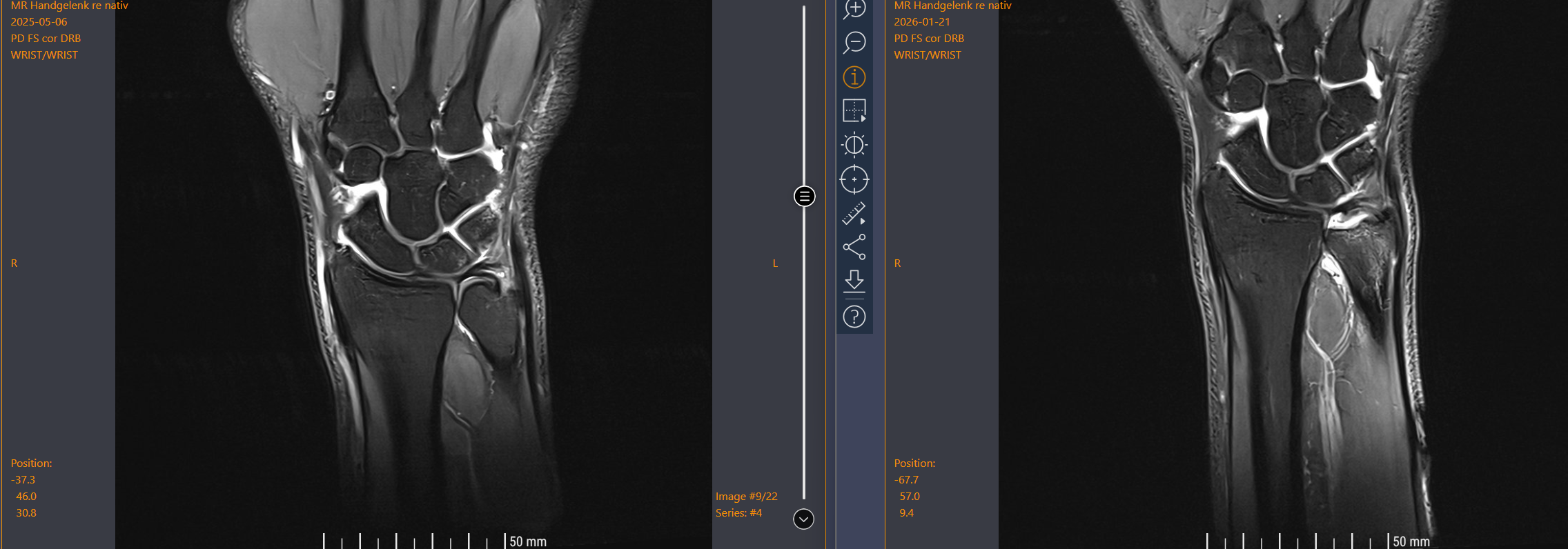
I just sent you a link with the MRI results before and after.
Feel free to reach out if you have any questions.

In case anyone else is interested, here you can see the shortening of the ulna quite clearly:

yjuqmoh4.png
 
Appreciate it! Question- How did you decide between the arthroscopic wafer procedure vs. the full ulnar shortening osteotomy?
For me, it was a relatively straightforward decision.

My surgeon, who is actually a highly respected specialist in hand surgery, initially recommended a full ulnar shortening osteotomy.

However, the potential drawbacks were too significant for me. I would have had to avoid putting any real strain on my arm for at least a year, as the ulna heals very slowly. Even after 12 months of rest, there is still a possibility that the bone may not have healed sufficiently and that a further period of recovery would be necessary — potentially several additional months.

There is also a risk of the bone developing a fracture or other complications during the healing process. Although this is monitored regularly with imaging, the high loads placed on the wrist and forearm during tennis naturally make this a relevant concern.

Ultimately, these factors were decisive for me.

With an arthroscopic wafer procedure, the main issue is that you may lose some range of motion in the wrist. For tennis, that can potentially have a significant impact, especially when it comes to certain shots and wrist positions. This was also one of the reasons Dominic Thiem reportedly decided against this procedure.
 
Back
Top